TL;DR:
- A certificate of authenticity is a signed record linking artwork to its origin, required at sale or delivery. Verifying the certificate involves matching artwork details, signatures, and accessing online archival records. Tortuga Creations includes hand-signed COAs with unique serial codes and QR links to ensure provenance and protection against fraud.
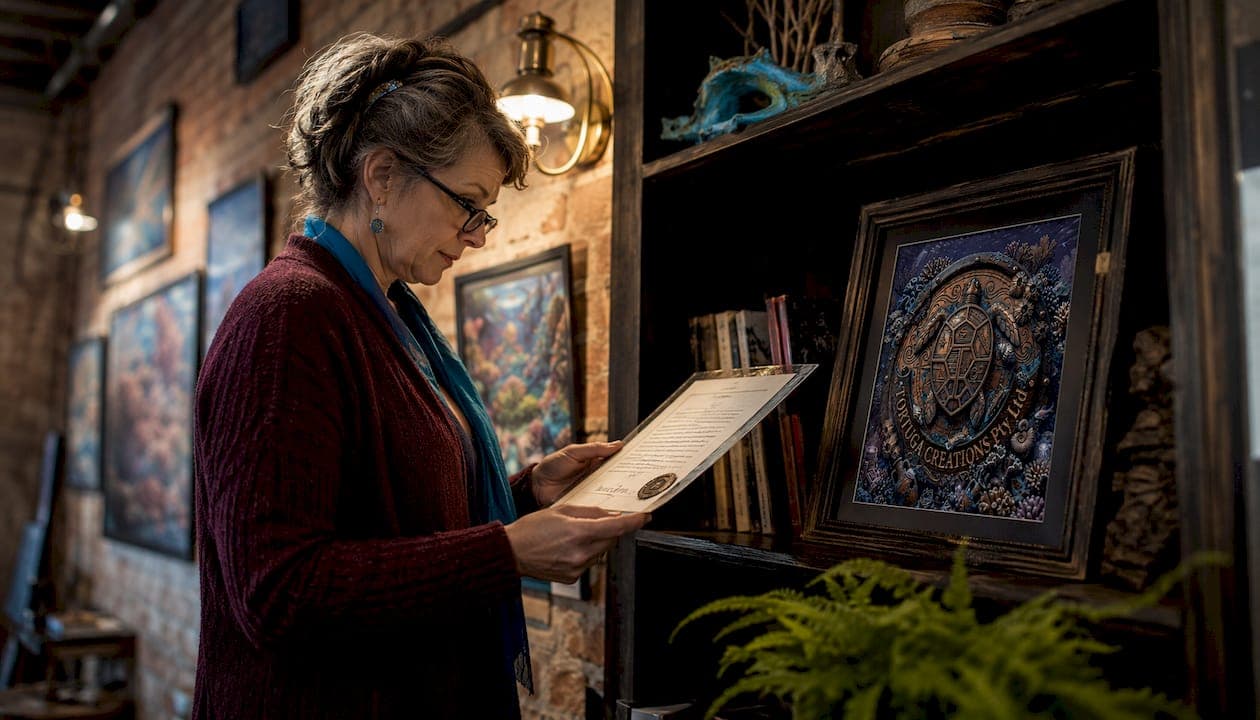
A certificate of authenticity (COA) is the creator's signed record tying an artwork to its origin, and it must be handed to you at the point of sale or delivery. No exceptions. Before you accept any original piece, check three things immediately: the certificate carries a hand signature and issue date, the artwork details on the certificate match the physical piece in front of you, and there is a verifiable contact or archival link you can follow up independently.
At Tortugacreations (Tortuga Creations Pty Ltd), every eligible original artwork and authored book ships with a COA. Here is what that means for you as a collector, and how to verify any certificate you receive.
Quick buyer checklist:
- Signed COA with issuer name and date
- Photo on the certificate matches the artwork
- Serial code or unique identifier present
- Archival link (QR code or online record) you can access
- Invoice or bill of sale kept alongside the certificate
Table of Contents
- What a proper certificate of authenticity should include
- Physical vs digital COA: which approach actually protects you?
- How to verify a COA step by step
- Why a COA matters beyond the price tag
- What you receive when you buy from Tortugacreations
- Storing, transferring, and replacing your certificate
- Legal notes and how to spot a fraudulent COA
- Key takeaways
- Why we sign every certificate by hand
- Collect with confidence from Tortugacreations
- Useful sources
- FAQ
What a proper certificate of authenticity should include
A COA is a definitive record of origin and condition, not just a price-justification document. Every field on it serves a purpose, and a missing field is a red flag worth questioning before money changes hands.
Core artwork fields:
- Artist or studio name (e.g. Tortuga Creations Pty Ltd / Philip Diaz)
- Title of the work
- Year of completion
- Medium and materials used
- Dimensions
- Edition or serial number (for limited runs or numbered prints)
Provenance and condition fields:
- Date of sale and previous ownership history (if applicable)
- Exhibition or publication history
- Condition notes and a high-resolution photo of the artwork
Issuer details:
- A clear statement of authenticity
- Hand signature (preferred over a printed facsimile)
- Issuer contact information
- Date of issue and any copyright or reproduction restrictions
Practical security additions:
- Unique serial code or holographic sticker
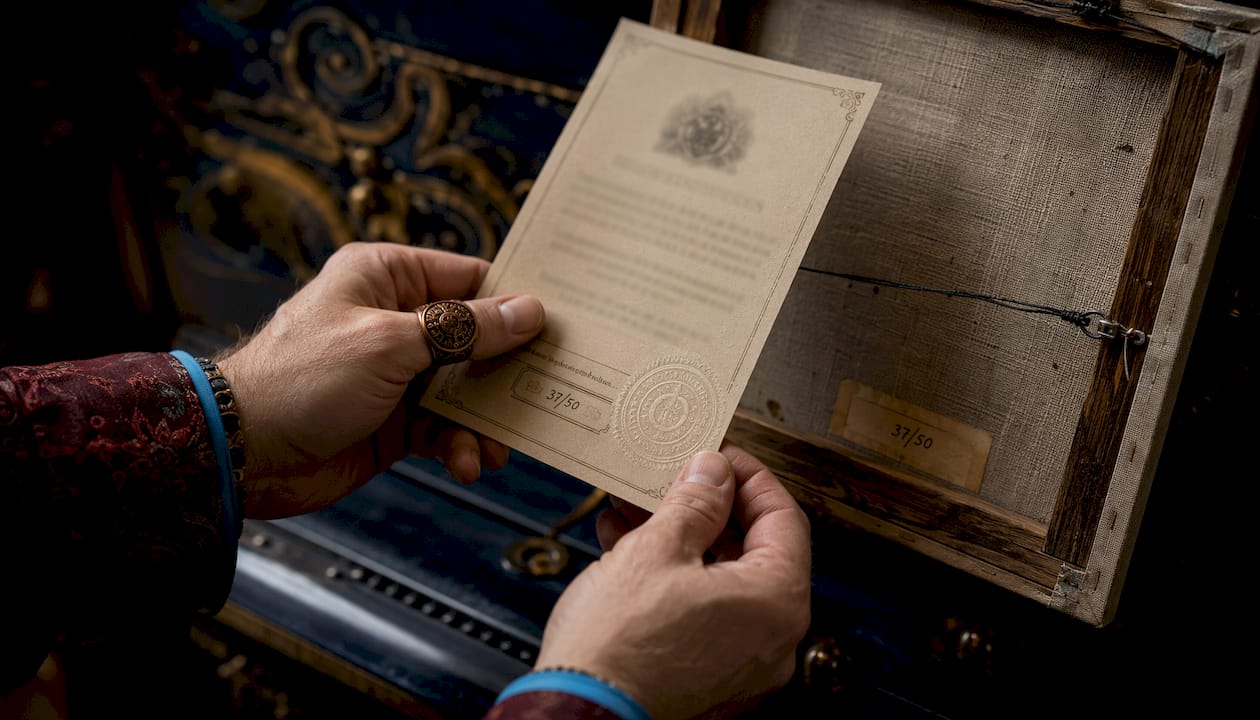
- Matching label affixed to the reverse of the artwork
- Archival care instructions
- QR code linking to an online archival page
Matching identifiers on both the certificate and the artwork reverse prevent swapping, which is one of the oldest tricks in art fraud.
Pro Tip: A handwritten signature remains the industry standard for physical COAs. If a certificate arrives with only a printed name where the signature should be, contact the issuer before accepting the work.
Physical vs digital COA: which approach actually protects you?
| Feature | Physical COA | Digital COA | Hybrid (recommended) |
|---|---|---|---|
| Tangible proof | Yes | No | Yes |
| Hand signature | Yes | No (digital sig) | Yes |
| Tamper evidence | Limited | Strong | Strong |
| Transferable globally | Slow | Instant | Both |
| Insurer/institution acceptance | Immediate | Varies | Best of both |
| Forgery resistance | Moderate | High | Highest |
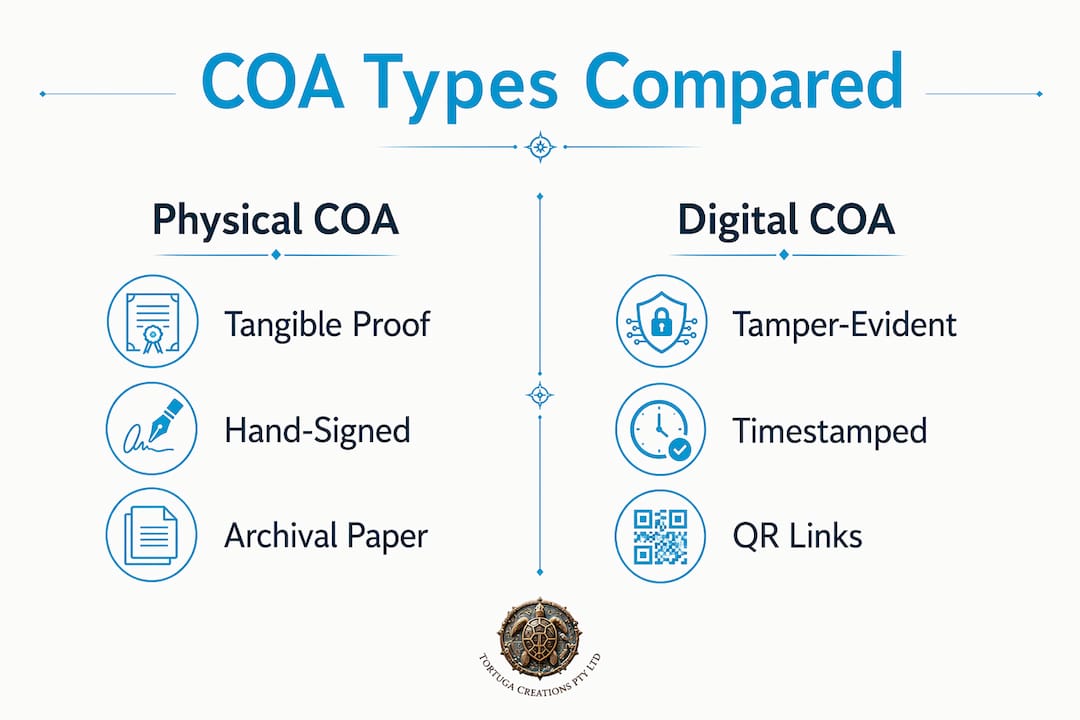
A physical certificate on acid-free, heavy-stock paper is still what insurers and galleries reach for first. It is tangible, it carries a real signature, and it does not depend on a server staying online. The weakness is that paper can be lost, damaged, or separated from the artwork over time.
Digital COAs add tamper-evident signatures, timestamped transaction histories, and QR or NFC links to online archival pages that update as ownership changes. Modern systems use QR codes or NFC tags linking to a provenance record, so every transfer is logged automatically.
The hybrid approach combines both: a physical certificate with a unique serial code that links to an unlisted online archival page. This is what professionals now recommend, and it is the model Tortugacreations uses. When you buy an original poster or authored book from the studio, you get the paper certificate and the digital record, tied together by a serial code.
Ask any issuer: Where is the online record hosted? Who controls editing rights? Is the digital record timestamped or cryptographically signed?
How to verify a COA step by step
- Match the certificate to the artwork. Check the photo, dimensions, title, and serial number against the physical piece. Any discrepancy needs an explanation from the seller before you proceed.
- Confirm the signature and issuer contact. Look up the issuer independently, not using contact details printed only on the certificate itself. For Tortugacreations, use the studio contact page or your order record.
- Scan the QR code or visit the archival link. The online record should show the artwork details and issue date. If the link is broken or the page is blank, that is a problem worth raising immediately.
- Cross-check with your invoice. The COA date should align with your bill of sale. A certificate dated years before or after the purchase without explanation is unusual.
- For high-value works, go further. Request a bill of sale, full provenance documents, and consider an independent condition report or appraisal before finalising payment.
COAs can be issued by the artist, a gallery, a publisher, or an authorised third party. The issuer's credentials and contact details must appear on the document itself.
Pro Tip: For sports memorabilia and entertainment-themed art, authentication practices for rare collectibles overlap significantly with art COA verification. The same multi-point check applies.
Why a COA matters beyond the price tag
A certificate of authenticity does more than confirm you paid for something real. It creates a provenance trail that supports resale, insurance claims, and institutional recognition. Galleries and museums rely on documented provenance when considering loans or acquisitions. Insurers need it to value and cover a work accurately.
Issuing COAs from the start of a career builds a provenance trajectory that supports later resale, exhibition, and institutional acquisition. For collectors, that trajectory is the difference between a piece that holds its value and one that becomes difficult to sell without a discount.
Edition numbers and reproduction rights, both recorded on the COA, protect you from discovering later that your "limited edition" print was one of thousands. Sellers benefit too: clear documentation reduces disputes and builds buyer confidence over time.
Presentation matters. Certificates are typically produced at A4 size (approximately 21.6 × 29 cm), printed on acid-free stock. A certificate that looks and feels substantial signals that the issuer takes provenance seriously.
What you receive when you buy from Tortugacreations
Tortuga Creations Pty Ltd issues a hand-signed physical COA on acid-free archival stock with every eligible original artwork and authored book. Here is exactly what comes with your purchase:
- Hand-signed physical COA on heavy, acid-free paper, signed by Philip Diaz
- High-resolution photo of the artwork included on or with the certificate
- Unique serial code matching a label on the reverse of the artwork
- QR code linking to an unlisted online archival page held in the studio archive
- Studio record retained by Tortuga Creations Pty Ltd to support future provenance enquiries
The studio archive means that even if your physical certificate is lost or damaged, the provenance record exists independently. Replacement certificates are available on request with proof of purchase and may carry a fee; replacements are marked as reissued. Digital upgrades (additional archival page access or updated QR links) are available by contacting the studio directly.
Original poster art pieces like the Magic Johnson Showtime LA Lakers poster and the Iron Mike Series each ship with full COA documentation.
Pro Tip: Keep your invoice, packaging note, and condition report in the same archival folder as your COA. Together, these documents form a complete provenance file that any future buyer, insurer, or institution will want to see.
Storing, transferring, and replacing your certificate
Short-term care:
- Store the COA in an acid-free sleeve or folder
- Keep it away from direct light and humidity
- Never use staples or adhesives near the certificate
Long-term archival:
- Use an archival box or framed document holder for originals
- Scan the certificate and store a dated digital copy in a secure cloud backup
- Note the scan date so future owners know when the digital copy was made
Transferring with a sale:
- Always include the COA, original invoice, and any provenance files with the artwork
- Note the ownership transfer on the online archival page if the issuer supports it
- Provide the new owner with the studio contact details for independent verification
Replacing a lost COA: Contact Tortuga Creations Pty Ltd with your original proof of purchase. Replacements are marked as reissued and may carry a fee. The studio archive record remains intact regardless, supporting provenance continuity.
Long-term archival value depends on paper quality and care conditions; acid-free stock and stable storage are the baseline.
Legal notes and how to spot a fraudulent COA
A COA is strong evidence of provenance, but it is not an absolute legal guarantee of authenticity. For high-value works, seek an independent appraisal or insurer guidance before finalising a purchase. This article is general information, not legal or financial advice.
Common fraud signals to watch for:
- Blank or inconsistent key fields (no serial number, no issuer contact)
- Photo on the certificate does not match the artwork
- Certificate printed on low-quality, non-archival paper
- No unique code or hologram on either the certificate or the artwork reverse
- Issuer contact details that cannot be independently verified
Practical prevention:
- Insist on a verifiable issuer contact before purchase
- Check for a matching label or hologram on the artwork reverse
- Request a bill of sale and keep all communication trails
- For second-hand purchases, contact the original issuing studio directly
Pro Tip: Never rely solely on contact details printed on the certificate. Search for the studio or artist independently and cross-reference. A legitimate issuer will always be reachable through channels outside the document itself.
Key takeaways
A certificate of authenticity is a provenance tool that preserves the value of your artwork, and it should be treated as part of the artwork itself, not disposable paperwork.
Collector micro-checklist:
- Insist on a signed COA at purchase
- Match the photo and serial number to the physical piece
- Verify the issuer contact independently
- Scan the QR code or archival link
- Store the COA with your invoice in an acid-free folder
| Point | Details |
|---|---|
| COA at purchase | Always receive a signed COA at sale or delivery; never accept an unsigned or incomplete certificate. |
| Essential fields | Artist, title, date, medium, dimensions, serial number, issuer contact, and a photo are all required. |
| Hybrid approach | A physical certificate plus a QR-linked online archival record gives the strongest provenance protection. |
| Storage and transfer | Keep the COA in acid-free storage and always pass it with the artwork on resale. |
| Tortugacreations | Every eligible original artwork and authored book from Tortuga Creations Pty Ltd includes a hand-signed COA on archival stock with a unique serial code and QR-linked archival page. |
Why we sign every certificate by hand
There is a view in some corners of the art world that digital records alone are sufficient, that a QR code and a blockchain entry replace the need for a physical, signed document. We disagree, and not just for sentimental reasons.
A hand-signed certificate is a commitment. It means the creator stood behind the work at a specific moment in time and put their name to it in a way that cannot be quietly edited later. The digital record matters enormously for transfers, insurance, and global resale. But the physical signature is what makes the provenance feel real to the collector holding it.
At Tortugacreations, we sign every COA because our work, whether it is an archive-quality poster documenting a sporting legend, a hardcover book preserving cultural history, or a business blueprint built from years of creative practice, deserves that level of care. The certificate is not an afterthought. It is part of what you are buying.
Collectors can contact the studio at any time for verification, provenance enquiries, or to discuss custom commissions. We keep the archive records so that decades from now, the story of the piece is still intact.
Collect with confidence from Tortugacreations
Tortugacreations ships archive-quality original poster art and authored books Australia-wide, each backed by a hand-signed COA on archival paper, a unique serial code, and a QR-linked provenance record. You know exactly what you are getting before the parcel arrives, and the studio archive means the provenance record outlasts any single document.
The studio's range covers original poster art celebrating sporting icons, authored books documenting cultural and sporting milestones, business blueprint modules, the Build It Grow It Earn From It programme, proprietary AI prompts for content creation, and the free Life Resources Portal. Selected limited editions and blueprint posters also ship with full COA documentation.
Browse the original poster art collection or head straight to the authored books range to see what is currently available with COA documentation. For provenance checks, replacement certificates, or custom commission enquiries, contact the studio directly through tortugacreations.com.au.
Useful sources
- Tortuga Creations studio and shop — verification, contact, and full product range
- Original poster art collection — COA-backed archive-quality posters
- Authored books range — hardcover and blueprint publications with provenance documentation
- Jackson's Art Blog: What Is a Certificate of Authenticity? — industry overview of COA fields and best practice
- Artwork Archive: Do You Need a COA? — guidance for collectors and emerging artists
- Format: Certificates of Authenticity Complete Guide — hybrid physical/digital approach explained
- AGI Fine Art: How to Prepare a Professional COA — paper standards, presentation, and archival care
- ProofMark: Modern COA Practices — QR and NFC-linked provenance systems
- Next Gen Cards: How to Authenticate Rare Sports Memorabilia — authentication methods for entertainment and sports collectibles
FAQ
What is a certificate of authenticity for art?
A certificate of authenticity is the creator's signed document tying an artwork to its origin, recording the artist, title, date, materials, edition number, and issuer contact. It must be provided at the point of sale.
What fields must a COA include?
At minimum: artist or studio name, title, year, medium, dimensions, edition or serial number, a statement of authenticity, hand signature, issuer contact, and date of issue. A photo of the artwork and a QR-linked archival record strengthen the document further.
How do I verify a COA from Tortugacreations?
Match the serial code and photo on the certificate to the physical artwork, scan the QR code to access the online archival page, and contact the studio directly through tortugacreations.com.au using independently sourced contact details.
Is a COA a legal guarantee of authenticity?
No. A COA is strong evidence of provenance but not an absolute legal guarantee. For high-value works, seek an independent appraisal or insurer guidance before finalising a purchase.
What happens if I lose my COA?
Contact Tortuga Creations Pty Ltd with your original proof of purchase. The studio retains archive records to support provenance continuity; replacement certificates may carry a fee and will be marked as reissued.
Recommended
- Michael Jordan Poster Art — Explore the technical beauty of ART, design and sport with Tortuga Creations. Premium blueprint posters and technical dossiers for cricket and sneaker collectors. Shipping Australia-wide.
- Explore the technical beauty of ART, design and sport with Tortuga Creations. Premium blueprint posters and technical dossiers for cricket and sneaker collectors. Shipping Australia-wide.
- Tortuga Creations Poster Art — Explore the technical beauty of ART, design and sport with Tortuga Creations. Premium blueprint posters and technical dossiers for cricket and sneaker collectors. Shipping Australia-wide.