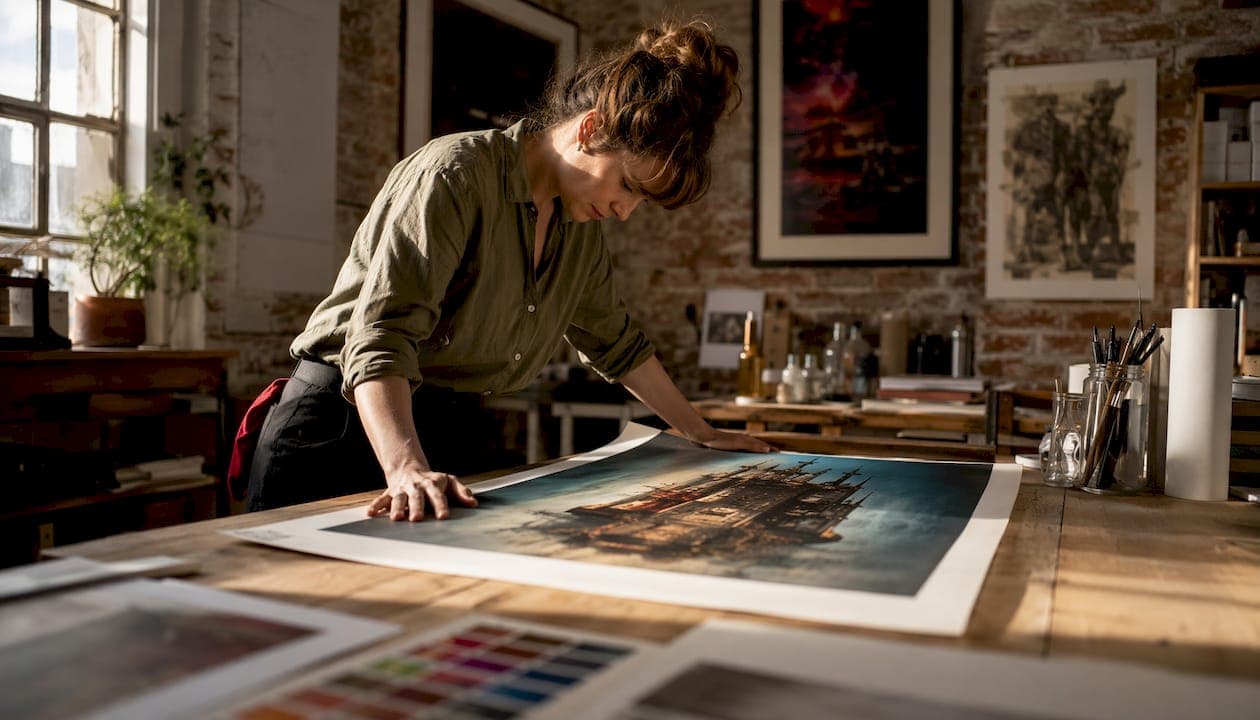
For artists and collectors in Australia's CBD and inner suburbs, the leading giclée printing studios are Pineapple Gallery, Pixel Perfect Studios, and Colour Factory. Giclée printing is a high-resolution inkjet process that uses pigment-based inks and archival substrates to produce museum-quality fine art reproductions. The term itself comes from the French word gicleur, coined around 1991 by printmaker Jack Duganne to describe prints made on modified large-format inkjet printers. What separates a true giclée from a standard digital print comes down to three things:
- High image resolution for sharp, close-up detail
- Pigment-based inks that significantly resist UV fading and humidity damage
- Acid-free, archival-quality substrates such as cotton rag, watercolor paper, or pre-coated canvas
These standards are what galleries and museums rely on. When a print is made correctly, the color stays true for decades, and the paper does not yellow or crack.
What are the best Australian giclée printing studios?
Three studios consistently stand out for artists and collectors across Australia's CBD and inner suburbs. Each brings a different strength to the table, so the right choice depends on what your work demands.
| Studio | Specializations and services | Print quality and technology | Available materials and sizes | Location | Rating |
|---|---|---|---|---|---|
| Pineapple Gallery | Fine art giclée prints, custom framing, archival finishing | Museum-grade archival materials, rapid turnaround | Cotton rag, watercolor paper, canvas; custom sizes | Australia | — |
| Pixel Perfect Studios | Photo and fine art printing, framing, canvas, metal prints | High-resolution output, expert color management | Canvas, fine art paper, metal; wide size range | Australia | 5★ (12 reviews) |
| Colour Factory | Fine art giclée printing, digital art reproduction | Archival pigment inks, color-managed workflow | Fine art paper, canvas; standard and custom sizes | Australia | — |
Pineapple Gallery is the strongest option for artists and collectors who prioritize gallery-quality finishing and fast delivery. Its focus on museum-grade archival materials means your edition prints arrive ready for exhibition or sale, not just display.
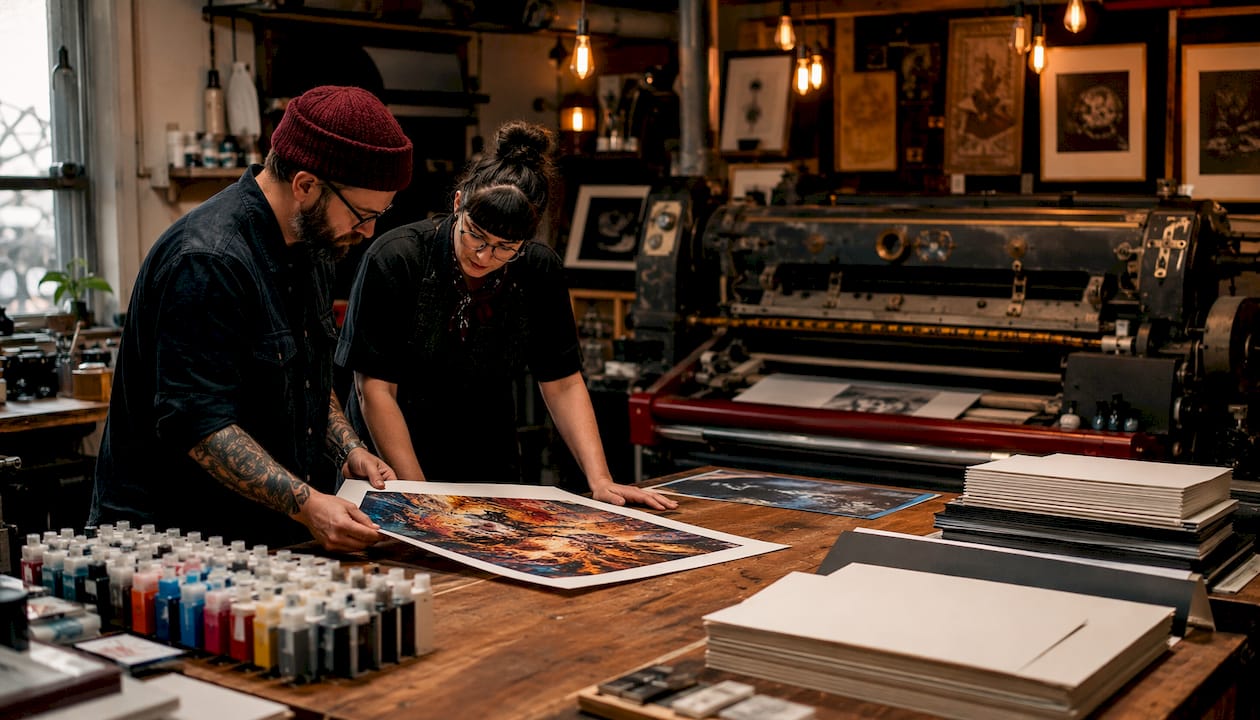
Pixel Perfect Studios suits photographers and artists who need precise color control across multiple print mediums. The studio's range extends to canvas and metal prints, which gives you flexibility if your work calls for something beyond paper.
Colour Factory rounds out the field with a solid archival pigment workflow and color-managed production. It is a practical choice when you need reliable digital art reproduction without the premium finishing extras.
For international benchmarks, East Bay Giclée in the US uses the Epson SureColor P9570 with UltraChrome PRO12 inks, sets order minimums and volume discounts on larger orders. Skink Ink Fine Art Printing focuses on wide color gamut, archival pigment printing, and exhibition-quality editions with global shipping. These studios set the standard that Australian providers are measured against.
How do you choose a giclée printing service in Australia?
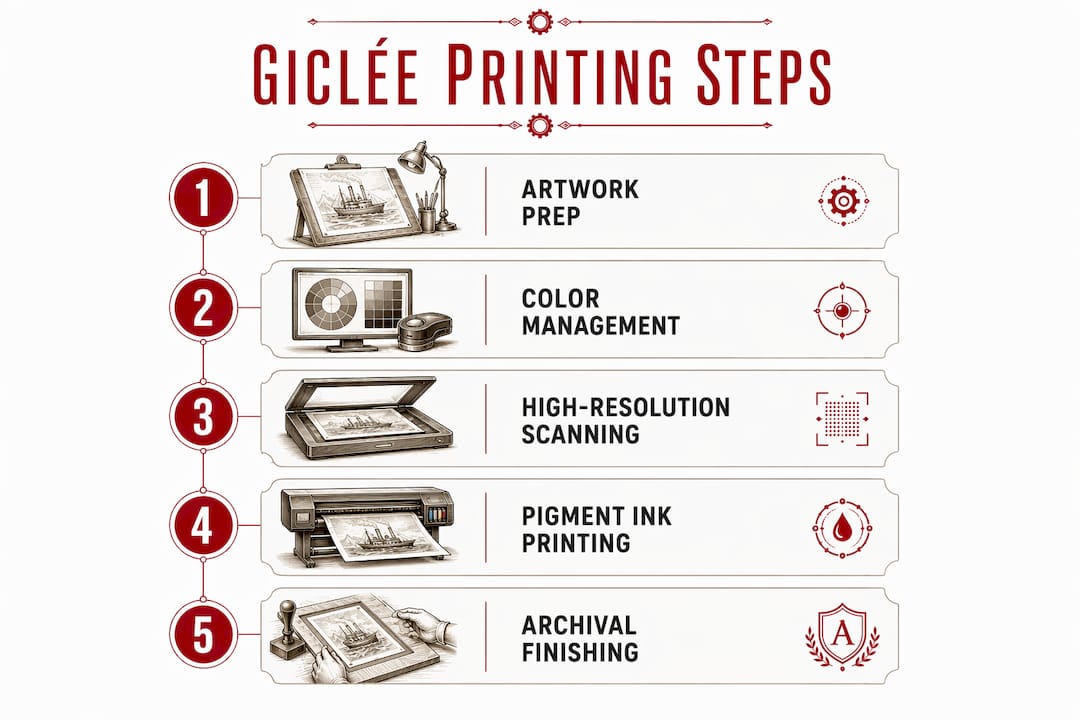
The technology a studio uses tells you a lot before you ever place an order. Printers like the Epson SureColor series with UltraChrome pigment inks deliver a wider color gamut and longer archival life than entry-level inkjet hardware. Ask directly what printer model and ink system the studio runs.
Color management is where many prints fall short. Professional labs use calibrated monitors, custom ICC profiles for each paper stock, and controlled lighting to match your digital file to the final print. A studio that skips this step will produce inconsistent results, no matter how good its hardware is.
- Check that the studio offers your preferred substrates: cotton rag, watercolor paper, or canvas
- Ask about turnaround time, especially if you have an exhibition deadline
- Confirm shipping options and how prints are packaged for transit
- Request a pricing sheet upfront, including any minimum order thresholds
- Ask whether the studio offers artist consultations for color-critical work
Pro Tip: Always request an artist proof before approving a full edition run. Test prints catch color mismatches that even a calibrated monitor cannot predict, and fixing the issue at proof stage costs far less than reprinting an entire edition.
Turnaround time varies widely across Australian studios. Some offer three to five business day production for standard sizes, while custom or large-format orders may take longer. If you are shipping interstate from the CBD, factor in transit time and ask whether the studio uses rigid packaging or tube rolling for paper prints.
What drives giclée print quality and longevity?
Archival pigment inks and acid-free papers are the two factors that determine how long a print survives. Pigment inks bond to the substrate surface rather than soaking in like dye inks, which makes them far more resistant to UV light, humidity, and handling. Paired with 100% acid-free cotton rag or watercolor paper, a correctly stored giclée print can last well beyond a human lifetime under museum conditions.
Giclée prints made with archival pigment inks on acid-free substrates significantly outlast traditional prints, with longevity measured in decades to a century under proper storage conditions.
The color gamut available through modern large-format inkjet printers is another advantage. Top-model printers use up to 12 ink channels, including light cyan, light magenta, and gray variants, to produce smooth gradients and accurate skin tones that four-color offset lithography cannot match. This is why galleries and museums specify giclée for limited-edition print runs.
The difference between a giclée and a standard art print is not just about ink. A regular commercial print uses CMYK offset lithography, which requires large minimum runs and fixed plate setups. Giclée printing lets artists print on demand, producing single prints or small editions without the cost of plate preparation or bulk storage.
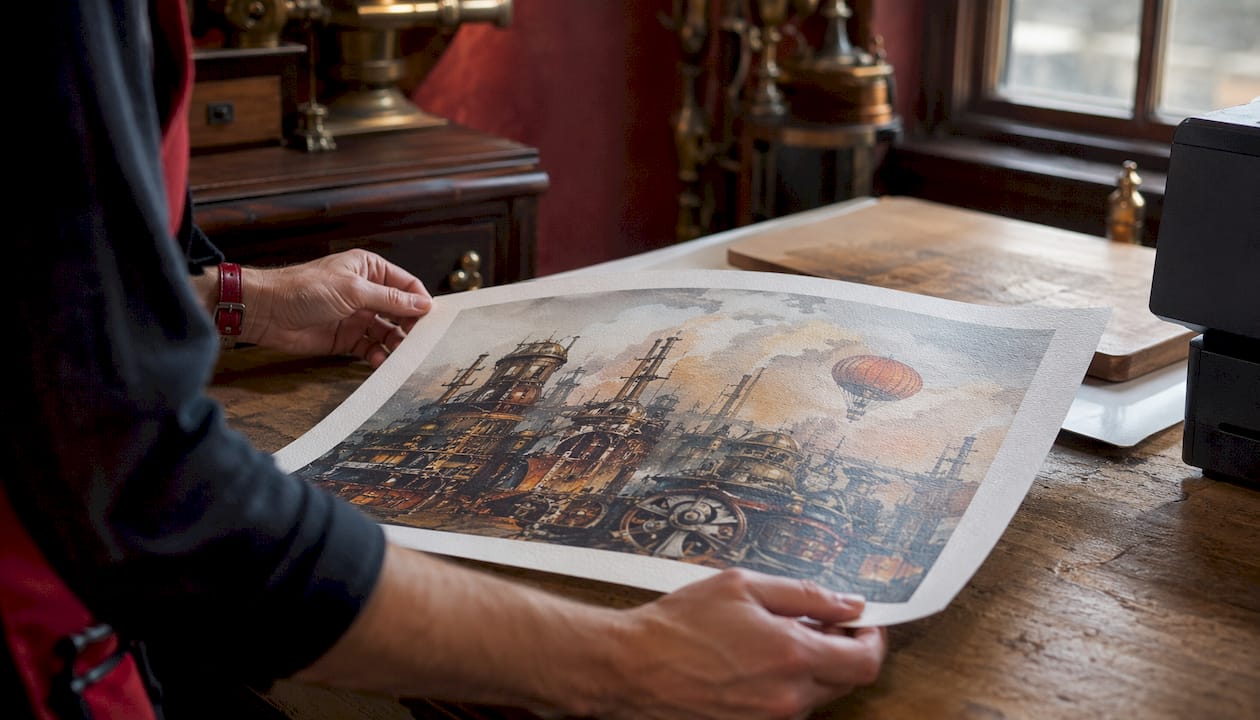
One emerging trend worth knowing: textured reproductions use UV-cured inks layered to capture brushstroke geometry and physical surface detail. These are technically distinct from traditional 2D giclée prints and suit collectors who want a tactile experience closer to the original painting.
The quality of your digital file matters as much as the printer. Successful giclée output starts with a high-resolution capture, whether that is a RAW photograph or a professionally scanned original, processed with correct lighting calibration and color profiling before it ever reaches the print queue.
How do you submit artwork for giclée printing?
Most Australian studios accept files digitally via upload portal, email, or file-sharing service. Before you submit, confirm the studio's preferred file format. Most require TIFF or high-resolution JPEG at 300 DPI or above, in the sRGB color profile for the most accurate print results.
If you are reproducing an original painting or drawing, professional artwork scanning is often a separate service. Studios like Skink Ink offer digitization as part of their workflow, capturing fine surface detail before the print stage. For large originals, some studios can arrange courier pickup or in-studio drop-off.
Once your file is received, a color-managed studio will run a soft proof against the target paper profile and flag any issues before production begins. This is the stage where you can request adjustments to brightness, contrast, or color balance. Clear communication at this point saves time and avoids reprints.
What custom finishing options are available?
Finishing choices shape how a print is experienced as much as the print itself. The most common options available through Australian giclée studios include:
- Paper types: Cotton rag, watercolor paper, baryta (fiber-based photo paper), and matte fine art paper each produce a different surface character and suit different work.
- Canvas printing: Pre-coated canvas stretched over a timber frame gives paintings a gallery-ready look without glass. Canvas also tolerates handling better than paper for shipping.
- Mounting: Dry mounting or foam-core backing gives paper prints rigidity for display. Acrylic face-mounting produces a high-gloss, contemporary finish popular for photography.
- Framing: Studios like Pineapple Gallery and Pixel Perfect Studios offer in-house custom framing with archival materials, including UV-filtering glazing that slows light-induced fading.
- Sizing: Most studios accommodate custom dimensions beyond standard sizes, which matters when you are reproducing work at a specific scale for an installation or a collector's brief.
Choosing the right substrate before you order is worth a conversation with the studio. A watercolor painting reproduced on cotton rag paper reads very differently from the same image on canvas, and the framing choice amplifies that difference further.
How do customer reviews reflect service reliability?
For artists placing high-value edition orders, service reliability matters as much as print quality. Pixel Perfect Studios carries a 5-star rating across its reviews, reflecting consistent output and client communication. Pineapple Gallery's positioning around rapid turnaround and museum-grade materials aligns with what working artists need when exhibition deadlines are fixed.
The most useful signals in any review are specifics: whether the studio communicated proactively about color issues, how prints were packaged for shipping, and whether the final output matched the approved proof. Generic praise tells you less than a single detailed account of how a studio handled a problem.
Tortugacreations: archive-quality art for collectors
If you are drawn to the world of archival fine art prints but want something you can own outright without commissioning a custom print run, Tortugacreations offers a different path. The studio produces original archive-quality posters and authored books that fuse historical research with high-end digital design, shipped Australia-wide.

This is not a printing service. It is a curated collection of finished art objects, from abstract watercolor tributes to technical blueprint dossiers for cricket and sneaker collectors. If you want a piece that is already designed, printed to archival standards, and ready to frame, Tortugacreations is worth a look alongside the printing services compared above.
Key Takeaways
Archival giclée printing requires pigment-based inks, acid-free substrates, and a color-managed workflow to produce fine art prints that last decades under proper storage conditions.
| Point | Details |
|---|---|
| Giclée defined | High-resolution inkjet printing with pigment inks and archival paper, coined in 1991 by Jack Duganne. |
| Longevity drivers | Pigment inks and acid-free substrates extend print life well beyond traditional commercial prints. |
| Top Australian studios | Pineapple Gallery, Pixel Perfect Studios, and Colour Factory each serve distinct needs for artists and collectors. |
| Artist proof stage | Always approve a test print before a full edition run to catch color mismatches before they become costly. |
| Tortugacreations | Offers finished archive-quality poster art and authored books shipped Australia-wide, as an alternative to commissioning custom prints. |
Recommended
- Explore the technical beauty of Art, Design and sport with Tortuga Creations. Premium blueprint posters and technical dossiers for cricket and sneaker collectors. Shipping Australia-wide.
- Explore the technical beauty of Art, Design and sport with Tortuga Creations. Premium blueprint posters and technical dossiers for cricket and sneaker collectors. Shipping Australia-wide.
- Tortuga Creations Poster Art — Explore the technical beauty of ART, design and sport with Tortuga Creations. Premium blueprint posters and technical dossiers for cricket and sneaker collectors. Shipping Australia-wide.
- Explore the technical beauty of Art, Design and sport with Tortuga Creations. Premium blueprint posters and technical dossiers for cricket and sneaker collectors. Shipping Australia-wide.