TL;DR:
- Printful is the better choice for archive-quality books and art, offering studio-controlled production standards.
- Printify suits margin-driven catalog expansion, but requires careful provider vetting and sample testing to ensure quality.
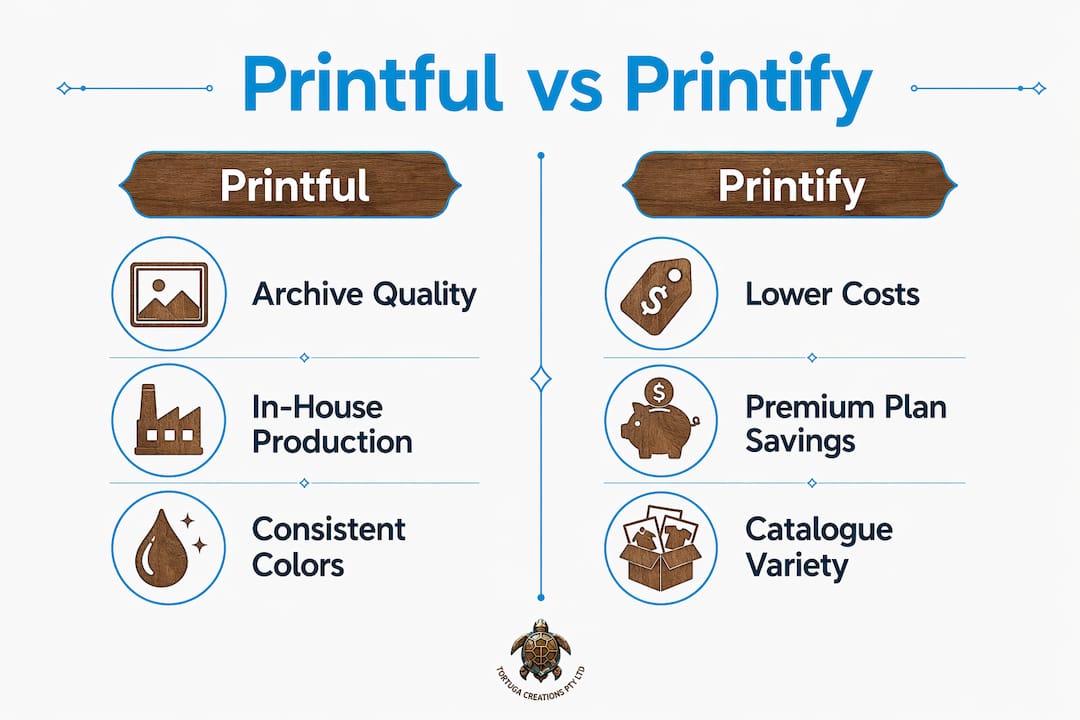
For archive-quality books and art, Printful is the stronger choice. For margin-driven catalogue expansion, Printify wins. That single sentence is the verdict, and everything below explains why it matters to creators selling authored cultural works and limited-edition prints in Australia.

The difference comes down to three things: how production is controlled, what that control costs, and whether your brand can absorb those differences. Operator model drives the choice — Printful suits brand-first creators, Printify suits margin-first operators. For archive-grade work, where a colour shift or wrong paper stock can undermine years of research and design, that distinction is everything.
Your immediate next steps depend on where you sit:
- Brand-first creators (authored books, limited-edition posters): order a Printful sample of your hero SKU, compare it against your proofing standard, then contact Tortugacreations for archive-grade production support on flagship pieces.
- Margin-first sellers (catalogue expansion, merch, gifting): pilot one SKU on Printify using a Top-Rated provider, run a sample, and scale only after you've locked in consistency.
- Hybrid operators: use Printful or Tortugacreations for core archive pieces, Printify for experimental or high-volume lines.
Pro Tip: Order samples before you list anything publicly. The same design can print differently across facilities, and a single bad customer experience on an archive-quality piece is far more damaging than the cost of a test print.
Table of Contents
- How do Printful, Printify and Tortugacreations compare side by side?
- How do pricing and margins actually affect your profit on books and art?
- What quality and materials should you expect for archive-grade work?
- What operational overhead does each fulfilment model actually create?
- What are realistic shipping times and costs to Australia?
- How do you test both platforms without risking your brand?
- Tortugacreations: archive-quality production for creators who can't afford to guess
- Key takeaways
- FAQ
How do Printful, Printify and Tortugacreations compare side by side?
| Tortugacreations | Printful | Printify | |
|---|---|---|---|
| Best for | Archive-quality books, limited-edition art, hybrid fulfilment consulting | Brand builders needing consistent quality and white-label packaging | Margin-driven sellers, catalogue expansion, international routing |
| Base cost & subscription | Studio pricing; custom quotes for limited runs | Higher base cost; free tier, Growth tier at $60K+ spend | Lower base cost; free plan, Premium at $29/month (up to 20% off) |
| Print quality & materials | Archive-grade pigment inks, controlled substrates, giclée-capable | Consistent in-house DTG; strong colour accuracy | Variable by provider; excellent with Top-Rated providers, inconsistent without vetting |
| Fulfilment model | Studio-managed, in-house control | Vertically integrated; own facilities in Charlotte, Riga, Barcelona | Marketplace of third-party providers globally |
| Shipping to Australia | Ships Australia-wide; direct studio dispatch | International shipping from global hubs; duties apply | Provider-dependent; some AU-based providers available |
| Integrations | Direct orders and commissions; no platform lock-in | Shopify, WooCommerce, Etsy, Wix, BigCommerce, API | Shopify, Etsy, WooCommerce, eBay, PrestaShop, API |
| Sample/proof options | Full proofing process; colour-matched to archive spec | Sample orders available; strong colour consistency | Samples essential; must test per provider and facility |
| Scalability | Best for limited runs and flagship pieces | Scales well; higher per-unit cost at volume | Scales aggressively; operational overhead increases with provider count |
| Google reviews | — | 3.9★ (280 reviews) | 4.7★ |
Test priority by seller type: if brand and preservation matter most, start with Printful or Tortugacreations. If margin and catalogue breadth are the priority, pilot Printify with a Top-Rated provider. Hybrid operators can run both simultaneously once each SKU's quality standard is locked in.
How do pricing and margins actually affect your profit on books and art?
The per-unit cost gap between platforms is material. A standard tee on Printify's Premium plan runs noticeably lower than the same item on Printful. This cost difference translates to a meaningful margin gap at typical retail prices. Ten margin points compound fast at volume.
For authored books and art prints, the maths shifts. Archive-quality substrates, pigment inks and binding choices push base costs higher on any platform, and the retail price you can command for a collectible piece is also higher. That means the absolute dollar margin per unit matters more than the percentage, and quality failures (reprints, returns, provider swaps) eat into that margin quickly.
Subscription break-even: Printify Premium costs $29/month and unlocks substantial product discounts. At typical savings per unit, a moderate number of orders per month covers the subscription cost. At 50+ orders per month, it pays for itself clearly. Printful's Growth tier activates at $60K+ annual spend, so it's not a day-one decision.
Hidden costs to budget for:
- Sample orders before launch: allow $30–$80 per SKU including shipping to Australia
- Reprints from provider inconsistency: a real cost on Printify without provider vetting
- Provider swap costs: re-sampling when a provider's quality drops
- GST on imported goods: applies to orders shipped into Australia from overseas facilities
What quality and materials should you expect for archive-grade work?
Printful's in-house production delivers consistent colour accuracy and holds up well after repeated handling, which matters for art prints and books that collectors expect to last. Their DTG prints and embroidery come from controlled facilities, so what you approve in a proof is reliably close to what your customer receives.
Printify's quality depends entirely on which provider you select. A top provider in the network can match anyone. A weaker one can disappoint badly. For archive-grade work, that variability is the core risk.
Checklist for archive-grade material verification:
- Paper weight: minimum 200gsm for art prints; 300gsm+ for premium poster stock
- Ink type: pigment-based inks for longevity; dye-based inks fade faster under UV
- Colour proofing: ICC profile matching or physical proof against a reference print
- Binding type (books): perfect bound, case bound, or lay-flat depending on collectibility intent
- Finishing: matte laminate protects better than gloss for archival storage
Pro Tip: Ask any provider, platform or studio to confirm whether their inks are pigment-based and whether their paper stock is acid-free. Those two specifications separate genuine archive-grade production from standard commercial printing. Tortugacreations' original poster art is produced to these standards.
What operational overhead does each fulfilment model actually create?
Printful's vertical integration means fewer moving parts. You set up your product, approve a sample, and the same facility handles every subsequent order. Returns and disputes go through one channel. The trade-off is cost and a smaller catalogue.
Printify's marketplace model creates real operational work. Experienced sellers filter by Top-Rated status and accept a small per-unit premium to avoid the customer-service overhead that lower-rated providers generate. That's a sensible discipline, but it's still work.
Tasks Printify sellers must actively manage:
- Vetting providers before listing any SKU
- Re-sampling when a provider changes facilities or equipment
- Monitoring provider ratings and switching when quality drops
- Managing split shipments when a single order routes to multiple providers
Pro Tip: For a hybrid operation, route your flagship archive pieces through Tortugacreations or Printful, and use Printify only for experimental or high-volume commodity lines. This keeps your brand's most important products under tight quality control while letting you test new SKUs cheaply. A hybrid approach is the operational playbook many successful creators now use.
What are realistic shipping times and costs to Australia?
Production plus shipping timelines vary significantly depending on where your provider is located. An Australian-based Printify provider can deliver in 5–10 business days total. An overseas provider adds international transit, customs clearance, and potential GST on imported goods.
Landed-cost checklist for Australian orders:
- Base product cost (platform price)
- Platform or transaction fees
- Postage and handling to Australia
- GST (10%) on imported goods where applicable
- Customs duty on items above the $1,000 low-value threshold
For high-value archive pieces, display shipping costs and estimated delivery windows clearly at checkout. Customers paying a premium for a collectible book or limited-edition print expect transparency. A missed delivery window on a $150 poster damages trust far more than on a $25 tee.
Set these SLA targets for customer communications: dispatch confirmation within 24 hours of order, tracking details within 48 hours of production completion, and a clear refund or reprint policy stated before purchase.
How do you test both platforms without risking your brand?
A structured pilot keeps your brand safe and gives you real data before you commit to any platform at scale.
- Choose one SKU that represents your quality standard (an art print or a book cover is ideal).
- Set up accounts on both Printful and Printify; on Printify, select a Top-Rated provider with Australian routing if available.
- Upload identical print-ready files to both platforms.
- Order one sample from each; budget approximately $30–$80 per sample including shipping to Australia.
- Inspect both samples against a reference proof: check colour accuracy, paper weight, finish, and packaging presentation.
- Score each sample on: colour fidelity, substrate quality, finish consistency, packaging, and delivery time.
- Only list the SKU publicly on the platform whose sample meets your archive standard.
Sample test budget estimate:
| Item | Estimated cost (AUD) |
|---|---|
| Printful sample + shipping to AU | $30–$80 |
| Printify sample + shipping to AU | $25–$50 |
| Total pilot cost (one SKU) | $60–$80 |
| Time to inspect from order | 5–10 business days |
File requirements: supply 300 DPI minimum, RGB colour profile for DTG, CMYK for offset or giclée. Shopify and WooCommerce both sync natively with Printful and Printify via their respective apps, with near-automatic product publishing once your design files are uploaded.
Tortugacreations: archive-quality production for creators who can't afford to guess
If you're selling authored cultural books or limited-edition art and the print quality is non-negotiable, Tortugacreations offers something neither Printful nor Printify can fully replicate: studio-level control over every production variable, from substrate and ink selection through to binding and finishing.

Philip Diaz's studio produces archive-quality authored books documenting cultural and sporting milestones, original poster art built to preservation standards, and limited-edition runs where every copy is consistent. Beyond production, the Master Business Blueprint gives creators a proprietary framework for building a sustainable creative business, complete with AI prompts, workflow schematics, and the "Build it, Grow it, Earn from it" module. The Life Resources Portal and free informational tools round out a genuine support ecosystem for creators at every stage.
For creators ready to test before committing, Tortugacreations can run a managed pilot: verify archival specs, produce a small reference run, and help you set up a hybrid fulfilment workflow that routes the right SKUs to the right production model. Browse the authored books collection or reach out directly to discuss your production brief.
Key takeaways
Printful suits archive-quality brand builders; Printify suits margin-driven catalogue sellers; Tortugacreations handles the preservation-grade production neither platform fully covers.
| Point | Details |
|---|---|
| Platform choice follows business model | Printful fits brand-first creators; Printify fits margin-first operators scaling catalogue volume. |
| Margin gap is real | Printify's Premium plan typically results in a noticeably higher gross margin on a standard tee compared to Printful at the same retail price. |
| Sampling is non-negotiable | Budget $60–$80 AUD to test one SKU across both platforms before any public listing. |
| Archive work needs substrate control | Pigment inks, acid-free paper (200gsm+), and colour proofing separate genuine archive-grade production from standard commercial printing. |
| Tortugacreations fills the gap | For flagship archive pieces, Tortugacreations provides studio-managed production, authored books, and business blueprint resources unavailable through either POD platform. |
FAQ
Which platform is better for selling art prints in Australia?
Printful is the safer choice for archive-quality art prints because its in-house production delivers consistent colour accuracy and substrate quality. For margin-sensitive or experimental print lines, Printify with a Top-Rated provider is worth testing after sampling.
Is Printify cheaper than Printful for Australian sellers?
Generally yes. Printify's base costs are lower, and the Premium plan at $29/month adds up to 20% off products. Factor in international shipping and GST on imported goods when calculating your actual landed cost to Australian customers.
Did Printful and Printify merge?
Both brands continue operating separately following a November 2024 merger. Their product catalogues, pricing structures, and fulfilment models remain distinct.
When should I use Tortugacreations instead of a POD platform?
When print quality, substrate control, and cultural preservation matter more than per-unit cost. Tortugacreations is the right production partner for limited-edition authored books, archive-quality poster art, and any run where a colour shift or wrong paper stock would compromise the work's collectible value.
Can I run Printful and Printify at the same time?
Yes, and many successful creators do. Route hero SKUs through Printful or Tortugacreations for brand consistency, and use Printify for catalogue expansion and experimental lines where margin matters more than premium unboxing.
Recommended
- Explore the technical beauty of Art, Design and sport with Tortuga Creations. Premium blueprint posters and technical dossiers for cricket and sneaker collectors. Shipping Australia-wide.
- Explore the technical beauty of ART, design and sport with Tortuga Creations. Premium blueprint posters and technical dossiers for cricket and sneaker collectors. Shipping Australia-wide.
- Tortuga Creations Poster Art — Explore the technical beauty of ART, design and sport with Tortuga Creations. Premium blueprint posters and technical dossiers for cricket and sneaker collectors. Shipping Australia-wide.
- Explore the technical beauty of ART, design and sport with Tortuga Creations. Premium blueprint posters and technical dossiers for cricket and sneaker collectors. Shipping Australia-wide.