TL;DR:
- In Australia, self-published printed books for retail or library sale must own their own ISBNs from Thorpe-Bowker.
- Each book format and edition requires a unique ISBN, which helps with discoverability and sales tracking globally.
If you're publishing a printed book for sale through bookstores, online retailers, or libraries in Australia, you need an ISBN. Full stop. Buy one from Thorpe-Bowker / MyIdentifiers before you submit your files anywhere. If you're releasing an eBook exclusively through a single platform like Amazon KDP, a platform identifier may be enough for now, though owning your own ISBN gives you control that a free platform ID never will.
Quick decision map:
- Print book for retail or libraries → buy your own ISBN now
- eBook distributed across multiple platforms → buy your own ISBN for portability
- eBook exclusive to one platform (KDP, etc.) → platform ID is optional but limiting
- Audiobook → needs its own separate ISBN
Pro Tip: Even if you're starting with a single eBook, buying a 10-pack upfront costs significantly less per unit than buying singles, and those ISBNs never expire.
Table of Contents
- What does an ISBN actually do for your book?
- Do you need an ISBN? A simple decision guide for Australian self-publishers
- How to buy and register ISBNs in Australia, step by step
- Free ISBNs from platforms: what you gain and what you give up
- Do separate formats and editions need their own ISBNs?
- Barcodes for printed books: what you need to know
- National Library of Australia and legal deposit: what Australian publishers must do
- How many ISBNs should you buy?
- What to prepare before you assign an ISBN
- Key takeaways
- Why imprint ownership matters more than most guides admit
- Tortugacreations has already done this work, and you can see how
- Useful sources and official guidance
- FAQ
What does an ISBN actually do for your book?
An ISBN (International Standard Book Number) is a 13-digit identifier that ties your title, edition, format, and publisher metadata to the global book supply chain. Every retailer, wholesaler, and library system uses it to find, order, and track your book.
The practical benefits are real and specific:
- Discoverability: Your book's information is stored in Books in Print and similar catalogues consulted by retailers and libraries worldwide.
- Sales tracking: Bookscan and similar reporting tools track sales by ISBN, giving you accurate data.
- Edition and format clarity: A paperback and a hardcover of the same title are distinct products in every supply chain system, each with its own ISBN.
- Publisher identity: The ISBN registration names your imprint as publisher of record, which is how the world sees your brand.
One thing an ISBN does not do: it provides no legal copyright protection. Copyright exists automatically when you create the work. The ISBN is purely a commercial and bibliographic identifier.
The metadata you register with your ISBN, including title, author name, imprint, format, and publication date, is what populates those global supply chains and library catalogues. The International ISBN Agency treats metadata accuracy as the most critical element of the entire system. Get it wrong once and you'll spend weeks chasing corrections across dozens of databases.
Do you need an ISBN? A simple decision guide for Australian self-publishers
Printed books distributed for sale through retail channels or libraries require an ISBN. That covers bookstores, online retailers like Booktopia, and any library supply arrangement. No ISBN means no barcode, no catalogue entry, and no way for a bookseller to order your book.
For eBooks, the rules are softer. Amazon KDP assigns its own ASIN, and many platforms accept books without a publisher-issued ISBN. But "optional" and "advisable to skip" are very different things.
When you must buy your own ISBN:
- Print books sold anywhere beyond your own website
- Any title you want stocked in Australian libraries
- Books distributed through wholesalers like Ingram
- Any format you plan to sell on multiple platforms
When a platform ID may be enough:
- An eBook sold exclusively through one platform, as a short-term test
- A hobby project with no plans for wide distribution
The bigger issue is publisher of record. When a platform supplies the ISBN, that platform's name appears as publisher in every bibliographic database, not yours. For a one-off experiment, that's a minor inconvenience. For an author building a creative imprint, it's a problem that compounds over time.
Pro Tip: If you're serious about your author brand, treat your imprint name the same way you'd treat a business name. Own the ISBN, own the record.
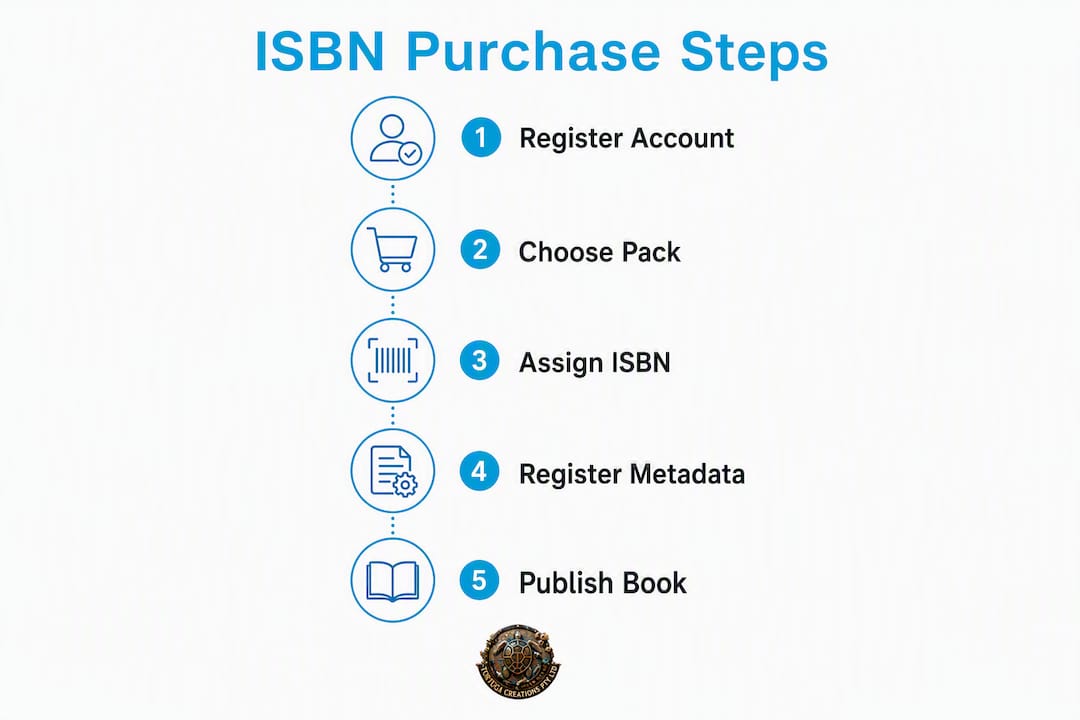
How to buy and register ISBNs in Australia, step by step
In Australia, ISBNs are issued through Thorpe-Bowker / MyIdentifiers Australia, the official national agency. The process is straightforward once you know the steps.
- Submit your metadata — to the National Library of Australia's prepublication data service.
The metadata step is where most self-publishers slip up. Imprint names with trailing spaces, author names with inconsistent capitalisation, or a format listed as "paperback" in one place and "softcover" in another will cause validation failures on platforms that cross-check ISBN registration. Enter everything exactly as it will appear on the book's cover and copyright page.
Australian ISBN pricing at a glance (Thorpe-Bowker / MyIdentifiers):
| Pack size | Approx. cost (AUD) | Per-ISBN cost |
|---|---|---|
| 1 ISBN | Check myidentifiers.com.au | Highest per unit |
| 10 ISBNs | Check myidentifiers.com.au | Significantly lower per unit |
| 100 ISBNs | Check myidentifiers.com.au | Lowest per unit |
Thorpe-Bowker updates its pricing periodically, so always check the current rates directly at myidentifiers.com.au before purchasing. For US market context, Bowker's example pricing shows a single ISBN at USD $125 versus a 10-pack at USD $295, demonstrating how much lower the per-unit cost is when you buy 10 at once.
Free ISBNs from platforms: what you gain and what you give up
Both Amazon KDP and IngramSpark offer free ISBNs, and the convenience is real. You don't pay upfront, and the ISBN is assigned automatically during the publishing workflow. But the trade-offs matter more than most new authors realise.
| Feature | Free platform ISBN | Your own purchased ISBN |
|---|---|---|
| Publisher of record | Platform name (e.g. "Independently published" on KDP) | Your imprint name |
| Portability | Locked to that platform | Use across any retailer or distributor |
| Library distribution | Limited or blocked | Full eligibility |
| Imprint branding | Platform's | Yours |
| Long-term cost | Free upfront, costly to fix later | Paid upfront, owned permanently |
Amazon KDP's free ISBN lists the imprint as "Independently published" and the ISBN can only be used on KDP. If you later want to distribute through Booktopia, Baker & Taylor, or an Australian library network, you'll need a new ISBN anyway, which means new metadata records and potential confusion in catalogues.
IngramSpark provides free ISBNs that may list an imprint such as "Indy Pub," with similar portability constraints. Once that ISBN is in the supply chain under another imprint's name, you can't retroactively claim it as your own.
Free ISBNs make sense for: a one-off personal project, a short-run test with no library ambitions, or a digital-only title on a single platform. They're a poor fit for any author building a recognisable imprint or planning to sell through Australian bookstores and libraries.
Do separate formats and editions need their own ISBNs?
Yes, and this catches a lot of indie authors off guard. Every distinct format and materially revised edition requires a unique ISBN. That means:
- Paperback → one ISBN
- Hardcover → separate ISBN
- ePub eBook → separate ISBN
- Audiobook → separate ISBN
- Revised or new edition → separate ISBN
The nuance with eBook file types: ePub and MOBI are different file formats, but most platforms treat them as the same edition and don't require separate ISBNs for each file type. A new ISBN is triggered by a change in format (print to digital), binding type (paperback to hardcover), or a material revision to the content.
You can reuse an ISBN only if nothing substantive has changed. Correcting a typo or updating a price does not require a new ISBN. Releasing a second edition with new chapters, a new introduction, or significant rewrites does.
Plan for multiple ISBNs per title if you intend to release paperback, eBook, and audiobook versions. That number climbs quickly for a catalogue of even five or six titles.
Barcodes for printed books: what you need to know
The barcode on the back cover of a printed book is an EAN-13, which is simply a graphical representation of the ISBN. Retail scanning requires this barcode on all printed books sold through physical channels. Without it, a bookstore's point-of-sale system can't process the sale.
A few practical points:
- Most print-on-demand services (including KDP Print and IngramSpark) generate and embed the barcode automatically when you supply an ISBN.
- If you're working with an offset printer or designing your own cover, you'll need to purchase or generate a barcode image separately and embed it in your cover file.
- Place the barcode on the lower-right of the back cover, with a minimum quiet zone (white space) of at least 2.5mm on all sides.
- The standard barcode size is approximately 37.29mm x 26.26mm; don't scale it below 80% or scanning reliability drops.
- Avoid encoding price data in the barcode unless your distributor specifically requires it. Encoding a price can cause problems if your retail price changes.
For cover design and prepress specifics, the book layout design guide covers barcode placement alongside spine width, bleed, and safe zones in practical detail.
National Library of Australia and legal deposit: what Australian publishers must do
Publishing in Australia carries a legal deposit obligation. The National Library of Australia's publishers and self-publishers service outlines the requirement: publishers must deposit copies of their works with the NLA, and most state and territory libraries have their own deposit requirements too.
Beyond legal deposit, the NLA's prepublication data service is worth using proactively:
- Register your ISBN and metadata early — so the NLA's catalogue has correct records at launch, not weeks after.
- Check state library requirements — separately, as South Australia, Victoria, and other states each have their own deposit rules.
- Trove — , the NLA's discovery platform, indexes Australian publications and is used by researchers, educators, and libraries nationwide. Correct metadata at registration means your book appears accurately in Trove searches from day one.
Timing matters here. Metadata submitted after publication often takes weeks to propagate through library catalogues. Submit early, and your book is discoverable the moment it launches.
How many ISBNs should you buy?
ISBNs never expire, so buying a block is a one-time investment you can draw on for years. The economics strongly favour buying more than you think you need right now.
Decision guide by publishing scale:
- One book, one format: A single ISBN works, but you'll pay the highest per-unit rate. If there's any chance you'll publish again, a 10-pack is smarter.
- One book, multiple formats (print + eBook + audio): You need at least 3 ISBNs. A 10-pack covers this title and gives you room for the next one.
- Active indie publisher or small press: A 10-pack is the minimum sensible purchase. A 100-pack makes sense once you have five or more titles in the pipeline.
| Scenario | ISBNs needed | Recommended pack |
|---|---|---|
| Single paperback only | 1 | 10-pack (future-proofing) |
| Paperback + eBook | 2 | 10-pack |
| Paperback + eBook + audiobook | 3 | 10-pack |
| 5+ titles across formats | 10+ | 100-pack |
Many indie authors underestimate how quickly formats and future revisions consume ISBNs. A catalogue of five titles across three formats uses 15 ISBNs before you've published a second edition of anything.
What to prepare before you assign an ISBN
Getting the metadata right before you assign an ISBN saves you from painful corrections later. Use this checklist every time.
- Finalised title and subtitle (exactly as they appear on the cover, including capitalisation)
- Author name (consistent spelling across all platforms and the copyright page)
- Imprint name (your publishing brand, not your personal name unless that's your imprint)
- Edition number (first edition, second edition, etc.)
- Format (paperback, hardcover, ePub, audiobook)
- Publication date (the date the book will be available for sale)
- Price (retail price in AUD for Australian distribution)
- Language (English, or the primary language of the text)
- Page count (for print editions)
- Binding type (perfect bound, case bound, saddle stitch)
- Cover file (print-ready PDF with barcode placement confirmed)
Manage your ISBN assignments in a simple spreadsheet with columns for: ISBN, title, format, assigned date, planned publication date, and platform. This takes ten minutes to set up and prevents the most common mistake in ISBN management, which is assigning the same ISBN to two different formats.
Pro Tip: Lock your title and imprint spelling before you assign the ISBN. Changing either after assignment means updating records across every platform and catalogue that has already indexed your metadata.
Key takeaways
In Australia, self-publishers who want print retail and library distribution must own their ISBNs; every format needs its own number, and buying a block from Thorpe-Bowker is almost always better value than buying singles.
| Point | Details |
|---|---|
| Print books need an ISBN | Any printed book sold through retail or libraries in Australia requires a purchased ISBN. |
| Each format needs its own | Paperback, hardcover, ePub, and audiobook editions each require a separate, unique ISBN. |
| Free ISBNs cost you control | Platform-supplied ISBNs list the platform as publisher of record, limiting portability and branding. |
| Buy in blocks | ISBNs never expire; a 10-pack costs far less per unit than singles and covers multiple formats. |
| Tortugacreations publishes with owned ISBNs | Tortugacreations registers its authored books and archive-quality releases under its own imprint for full catalogue control. |
Why imprint ownership matters more than most guides admit
Here's the thing most ISBN guides gloss over: the publisher-of-record field in a bibliographic record is not just an administrative detail. It's the name that appears in library catalogues, in Books in Print, in Trove, and in every wholesale database for the life of that edition. If you let a platform own that field, you're handing your brand's publishing history to a company whose interests are not yours.
The argument for free ISBNs is always framed as a cost saving. But the real cost is invisible until you try to move your book to a new distributor, apply for a grant that requires you to demonstrate publishing credentials, or pitch a library acquisition programme. At that point, "Independently published" or "Indy Pub" in the publisher field works against you in ways that are genuinely hard to undo.
Owning your ISBNs and registering your imprint is the publishing equivalent of owning your domain name. You wouldn't build a business website on a platform's subdomain and call it your brand. The same logic applies here. The upfront cost of a 10-pack is modest. The long-term value of a clean, consistent imprint record across every catalogue your books ever appear in is not.
Tortugacreations has already done this work, and you can see how
At Tortugacreations, Philip Diaz and the studio have built a publishing catalogue that treats every authored book as both a creative artefact and a properly registered commercial product. The Cricket Heritage Archive series and archive-quality blueprint dossiers are each registered under the Tortugacreations imprint, with metadata submitted to the National Library of Australia and distributed through proper retail channels.
If you're working on your own book and want to see what a properly structured, ISBN-registered publication looks like from cover to catalogue entry, the Tortugacreations authored books collection is a practical reference point. Beyond the books themselves, the studio's Business Master Blueprint and the Build it Grow it Earn from it module cover the business mechanics of running an author imprint, including metadata workflows, AI prompts for writing copy and descriptions, and the systems that turn a creative passion into a sustainable publishing operation. The Life Resources Portal adds free practical tools for authors at every stage. Head to the Tortugacreations shop to explore the full range and find the resource that fits where you are right now.
Useful sources and official guidance
These are the primary sources to consult for current rules, pricing, and deposit requirements:
- Thorpe-Bowker / MyIdentifiers Australia: The official Australian ISBN agency. Buy ISBNs, register metadata, and manage your title records here.
- International ISBN Agency: The global authority on ISBN standards, edition rules, and metadata requirements.
- National Library of Australia — Publishers and Self-Publishers: Official guidance on legal deposit obligations and the prepublication data service for Australian publishers.
- Amazon KDP ISBN help: KDP's own documentation on free versus purchased ISBNs and imprint naming.
- Bowker / MyIdentifiers (US): US ISBN agency; useful for understanding global ISBN standards and barcode services.
FAQ
Does my self-published book need an ISBN?
Printed books sold through retail channels or libraries in Australia require an ISBN. eBooks on many platforms may not require one, but owning your own ISBN provides wider distribution flexibility and control over your imprint as publisher of record.
How do I get an ISBN in Australia?
Register an account at myidentifiers.com.au, choose your pack size, purchase your ISBNs, and assign each one to a title with complete metadata. The process takes under an hour for a first-time user.
How much does an ISBN cost in Australia?
Thorpe-Bowker sets Australian ISBN pricing and updates it periodically; check myidentifiers.com.au for current rates. As a general guide, buying a 10-pack costs significantly less per ISBN than buying a single, and ISBNs never expire so the investment carries forward to future titles.
Do self-publishing platforms buy the ISBN, or does the author?
Either can. Platforms like Amazon KDP and IngramSpark offer free ISBNs, but those list the platform as publisher of record and restrict portability. Authors who want their own imprint name in bibliographic records should purchase ISBNs directly from the official national agency.
Can I use the same ISBN for my paperback and eBook?
No. Each format requires a separate ISBN. A paperback, hardcover, ePub, and audiobook edition of the same title each need their own unique number.