TL;DR:
- Proper storage of art prints involves flat support, acid-free materials, and controlled humidity to preserve their value. Using museum-standard framing with UV-filtering glazing protects prints on display, while regular condition monitoring ensures long-term stability. Implementing these practices makes preservation a deliberate and creative act that safeguards both the artwork and its future owner.
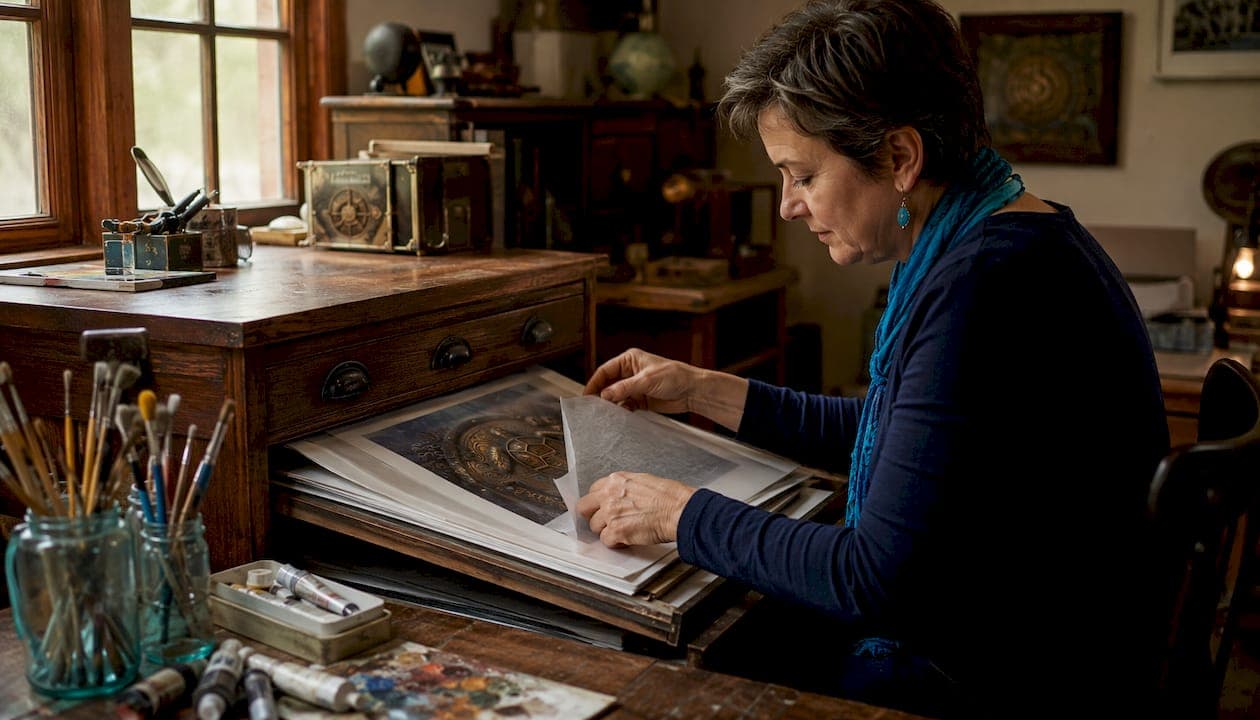
Store art prints flat, fully supported, and wrapped in acid-free, lignin-free materials — that is the single most important thing you can do to protect their condition and long-term value. Roll only when the format genuinely demands it. This guide pairs Library of Congress preservation guidance on light and humidity limits with museum framing standards and Tortugacreations' own studio practice, so you get conservation-grade advice that is practical and purchase-ready in Australia.
Three things to do right now:
- Place a hygrometer in your storage room and confirm relative humidity sits between 40–55%.
- Wrap each print in acid-free tissue before stacking — never face-to-face without a barrier.
- Remove any cardboard or brown paper in direct contact with your prints; both are acidic and cause yellowing over time.
Table of Contents
- How should you store art prints to protect them today?
- What materials do you need — and what should you avoid?
- Which storage method suits your collection?
- What environmental conditions keep prints stable long-term?
- How does museum-quality framing protect a print on display?
- Key takeaways
- Why preservation is a creative act, not just a chore
- Tortugacreations: archive-quality prints and resources for collectors
- Useful sources
- FAQ
How should you store art prints to protect them today?
- Move prints to an interior room away from exterior walls, basements, and bathrooms where temperature swings and moisture are worst.
- Slip each print into an acid-free sleeve or wrap it in acid-free tissue; interleaving sheets should be slightly larger than the print so every edge is covered.
- Lay prints flat inside an archival drop-front box or a lignin-free portfolio, never stacked face-to-face without a barrier.
- Drop a rechargeable silica gel sachet into the box to buffer humidity passively.
- Record each item in a simple inventory spreadsheet: title, edition number, condition notes, and a photograph front and back.
Flat vs rolled: flat storage is the right default for most collector-quality prints because it eliminates curl and stress. Rolling is acceptable for large-format works that genuinely will not fit flat, but only loosely around a wide-diameter core, stored horizontally, and never in a tight cardboard tube.
Pro Tip: A single digital hygrometer (under AU$20 at most hardware stores) and one rechargeable silica gel unit inside your storage box solves the majority of short-term humidity problems without any mechanical climate control.
What materials do you need — and what should you avoid?
Required specifications
Every material touching your print must be acid-free, lignin-free, and pH-neutral. In plain language: acid-free means the paper or board will not release corrosive compounds over time; lignin-free means it contains no wood pulp residue that yellows and becomes brittle; pH-neutral (ideally slightly buffered to pH 7.5–8.5) adds an alkaline reserve that neutralises any acids that migrate from the environment.
What to buy
- Acid-free interleaving tissue (glassine or conservation tissue) for separating prints
- Archival polyester (Melinex/Mylar) sleeves for short-term access and display; for long-term storage, paper interleaving is generally preferred because plastic sleeves can trap moisture and cause prints to stick
- Lignin-free drop-front (Solander) boxes — Lineco-style drop-front boxes are a conservator-recommended example widely available through Australian museum supply houses
- Buffered mat board (100% cotton rag) for backing and matting
- UV-filtering glazing (conservation glass or museum acrylic) for framing
What to avoid
- Cardboard, brown paper, and raw wood (all acidic)
- Ordinary tissue paper and newspaper
- PVC-containing plastic sleeves
- Rubber bands, sticky labels, and adhesive-backed tapes in direct contact with paper
Pro Tip: When ordering from an Australian conservation supplier, ask for the material data sheet and confirm the pH rating in writing. Reputable suppliers — search for museum supply, archival stationery, or conservation materials suppliers in your state — will provide this without hesitation.
| Material | Acceptable? | Notes |
|---|---|---|
| Acid-free tissue / glassine | Yes | Best for long-term interleaving |
| Archival polyester sleeve | Short-term | Risk of moisture trap in long-term use |
| Lignin-free drop-front box | Yes | Preferred for flat storage |
| Cardboard box | No | Releases acids; causes yellowing |
| Brown paper wrap | No | Acidic; avoid direct contact |
| PVC plastic sleeve | No | Off-gasses harmful compounds |
Which storage method suits your collection?
Comparing your main options
Archival drop-front boxes and steel flat-file cabinets are the two workhorses of serious print storage. Here is how they compare in practice:
| Method | Best for | Key advantage | Watch out for |
|---|---|---|---|
| Steel flat-file cabinet | Large collections, dealer inventory | Maximum flat support, lockable | Expensive upfront; needs level floor |
| Archival drop-front box | Small–medium collections | Portable, stackable, affordable | Do not overfill; limits airflow |
| Acid-free portfolio case | Prints in regular rotation | Easy access, protective cover | Less humidity buffering |
| Archival tube (wide core) | Oversized prints only | Space-saving for large formats | Rolling stresses paper fibres |
Safe handling step by step
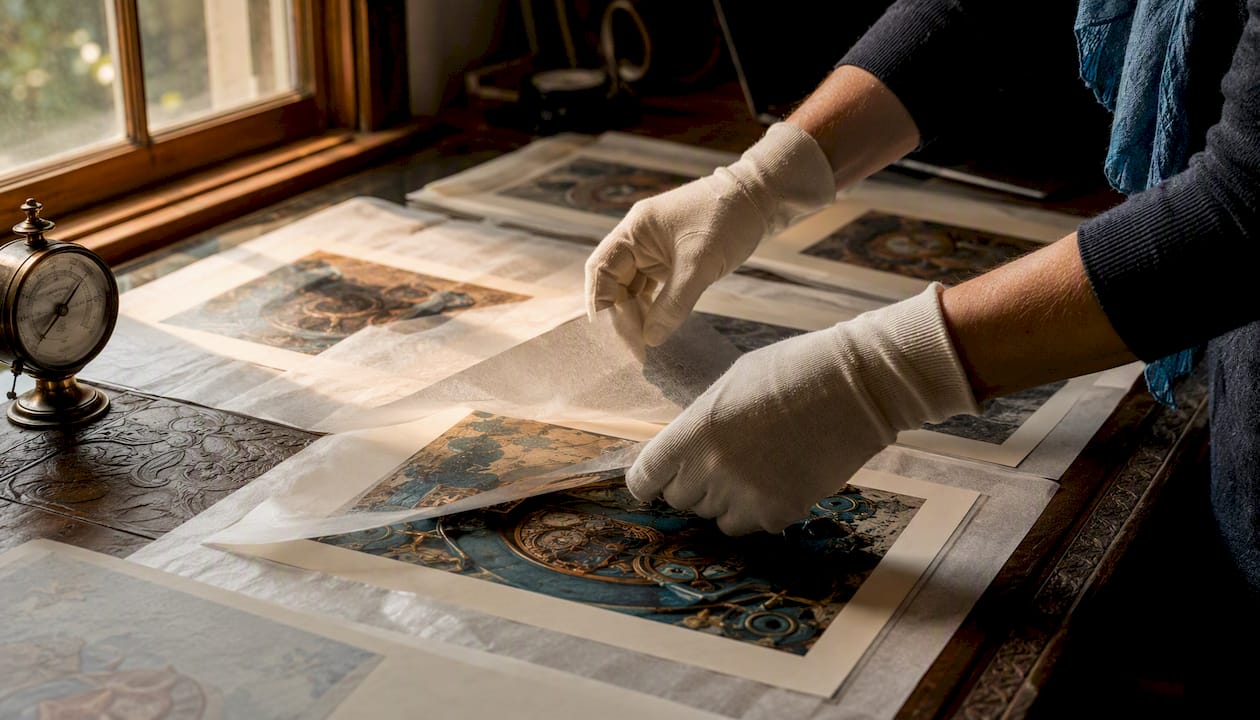
- Wash and dry hands thoroughly, or wear clean cotton gloves for works on delicate or matte surfaces.
- Support the full sheet from underneath — never lift from one corner.
- Lay the print on a clean, flat surface before moving it to its enclosure.
- When shipping or transporting, allow the carton to acclimate at room temperature for at least two hours before opening to prevent condensation.
Group prints by size within drawers and interleave every sheet. Overfilling a drawer causes the prints at the bottom to bow under pressure, which is exactly the kind of stress flat storage is meant to prevent.
What environmental conditions keep prints stable long-term?
Targets and monitoring schedule
| Parameter | Display limit | Storage target | Why it matters |
|---|---|---|---|
| Light (lux) | Below 50 lux | Below 5 lux | UV and visible light cause irreversible fading |
| Relative humidity | 40–55% | 40–55% | Fluctuation causes cockling, mould, and brittleness |
| Temperature | 18–22°C | 18–22°C | Heat accelerates chemical degradation |
These figures come from Library of Congress guidelines and are the accepted standard across Australian collecting institutions.
- Monthly: check the hygrometer reading and recharge silica gel if humidity has crept above 55%.
- Quarterly: open boxes, inspect for foxing (brown spots), mould, adhesive transfer, or insect activity.
- Annually: photograph each print as a condition record, rotate displayed works, and update your inventory.
Passive humidity management with rechargeable silica gel inside flat files is effective and low-cost for small to mid-size collections. Mechanical climate control becomes worthwhile once a collection reaches commercial scale or includes high-value originals.
Digitise as a backup. High-resolution scans with accurate metadata (title, edition, dimensions, condition notes) reduce loss risk and make condition comparisons across years far easier. For entrepreneurs selling prints, digital surrogates also support insurance claims and condition disputes.
How does museum-quality framing protect a print on display?
Framing is a preservation decision first, a decorative one second. Museum-quality framing is the single most important step for any print you intend to display.
- Acid-free/buffered mat board (100% cotton rag) prevents acid migration from the mount to the paper.
- Reversible hinging with Japanese tissue and wheat starch paste keeps the print attached without permanent damage; never dry-mount a print you value, as it cannot be undone without risk.
- Spacers between the print and glazing prevent condensation from bonding paper to glass.
- UV-filtering glazing (conservation glass or museum acrylic) blocks over 99% of UV light, the primary driver of fading on display.
Keep displayed works below 50 lux, away from direct sunlight, HVAC vents, and heat sources. Rotate works off display every 6–12 months to limit cumulative light exposure. For a detailed local framing walkthrough, the archival framing guide from Tortugacreations covers Eastern Suburbs options and step-by-step conservation choices.
Pro Tip: Before sending a print to a framer, ask specifically for a condition report and confirm they use reversible mounting. Keep the original packaging for transit — a print that survives framing can still be damaged on the way home.
Key takeaways
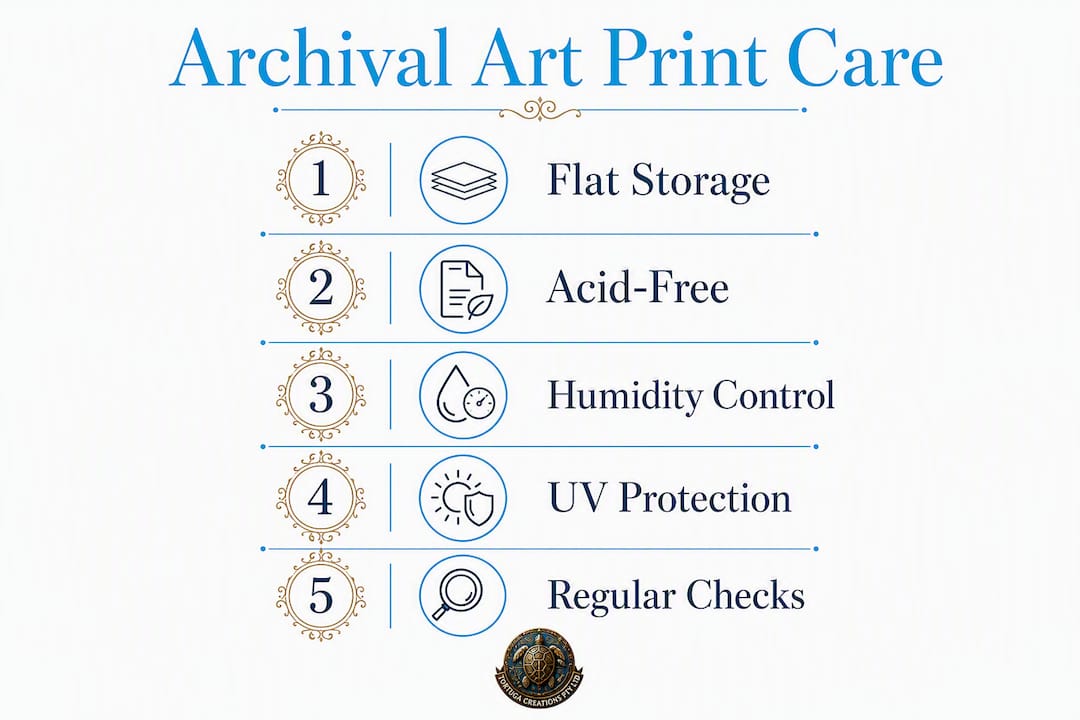
Proper archival storage requires flat support, acid-free materials, controlled humidity between 40–55%, museum-standard framing, and documented condition records — every one of these steps compounds the others.
| Point | Details |
|---|---|
| Store flat and supported | Lay prints in acid-free enclosures; roll only oversized works around a wide core. |
| Use acid-free materials only | Avoid cardboard, brown paper, and PVC plastics — all release acids that yellow paper. |
| Control humidity and light | Keep RH at 40–55% and storage light below 5 lux; use a hygrometer and silica gel. |
| Frame to museum standard | Acid-free matting, reversible hinges, spacers, and UV-filtering glazing protect on display. |
| Tortugacreations archival prints | Each print ships with archival wrap and suggested framing notes, ready for conservation storage. |
Why preservation is a creative act, not just a chore
Most collectors focus on acquisition and display, and that makes sense — the thrill of finding a great piece is real. What gets underestimated is how quickly the wrong storage environment can quietly undo years of careful collecting. A print stored in a cardboard box in a garage does not fail dramatically; it yellows slowly, foxes at the edges, and loses the crispness that made it worth owning in the first place.
The conventional wisdom treats preservation as a separate, technical concern you hand off to a conservator when something goes wrong. The better frame is to treat every storage and framing decision as part of the creative act itself. Choosing acid-free materials, controlling humidity, and framing with reversible mounts are the same kind of intentional choices that go into making a great piece of art. They reflect respect for the work and for the people who will own it after you.
For entrepreneurs managing print inventory, this matters commercially too. The same practices that protect collector value also reduce returns, disputes, and stock losses. Museum-grade basics are not expensive relative to the cost of replacing damaged stock or losing a sale because a print arrived in poor condition.
Tortugacreations: archive-quality prints and resources for collectors
Tortugacreations produces archive-quality poster art and authored books that document cultural and sporting milestones, all shipped Australia-wide with archival wrap and suggested framing notes included. Every print leaves the studio ready for conservation storage or museum-quality framing — no guesswork about materials or handling.

Beyond the prints themselves, the studio offers the Business Master Blueprint, the Build It Grow It Earn From It module, and proprietary AI prompts for content creation — practical tools for entrepreneurs who want to turn a creative passion into a sustainable business. Not ready to buy? The free Life Resources Portal is available now, and the authored books collection covers cricket heritage, sneaker culture, and design history in hardcover and digital formats. Browse the full range and find the piece that belongs in your collection.
Useful sources
- How to Care for Prints & Works on Paper — Austin Gallery; covers Library of Congress lux and humidity targets with practical collector guidance.
- Print Care: Handle, Frame & Preserve Art Prints — LEAP; detailed conservation framing checklist including glazing, matting, and reversible mounting.
- How to Store Prints So They Don't Curl, Crack, or Yellow — Art News & Views; accessible overview of acid-free materials and environmental controls.
- Poster Care: An Expert Guide — Fine Art Restoration; specialist guidance on conservation framing and reversible mounting for vintage and limited-edition prints.
- How to Store & Frame Art Prints — Hanga House; collector-focused framing and storage guide with notes on dry-mounting risks.
Keep an Australian conservation supplier and a professional conservation framer on call for any high-value or fragile piece — local expertise matters when a print needs hands-on assessment.
FAQ
What is the best way to store art prints long-term?
Store prints flat in acid-free, lignin-free enclosures — drop-front archival boxes or steel flat-file drawers — with acid-free tissue interleaving between each sheet, at 40–55% relative humidity and below 22 degrees Celsius.
Can you store posters rolled in a tube?
Rolling is acceptable for oversized prints that will not fit flat, but only loosely around a wide-diameter core stored horizontally; tight cardboard tubes stress paper fibres and cause permanent curl.
How do you protect art prints from UV damage?
Use UV-filtering glazing (conservation glass or museum acrylic) when framing, keep displayed works below 50 lux, and store unframed prints in a dark space below 5 lux.
What materials should you never use to store prints?
Avoid cardboard, brown paper, ordinary tissue, PVC plastic sleeves, rubber bands, and any adhesive-backed tape in direct contact with the print — all release acids or trap moisture that degrade paper over time.
How often should you inspect stored prints?
Check your hygrometer monthly, open and inspect storage boxes quarterly for foxing or mould, and photograph each print annually as a condition record.